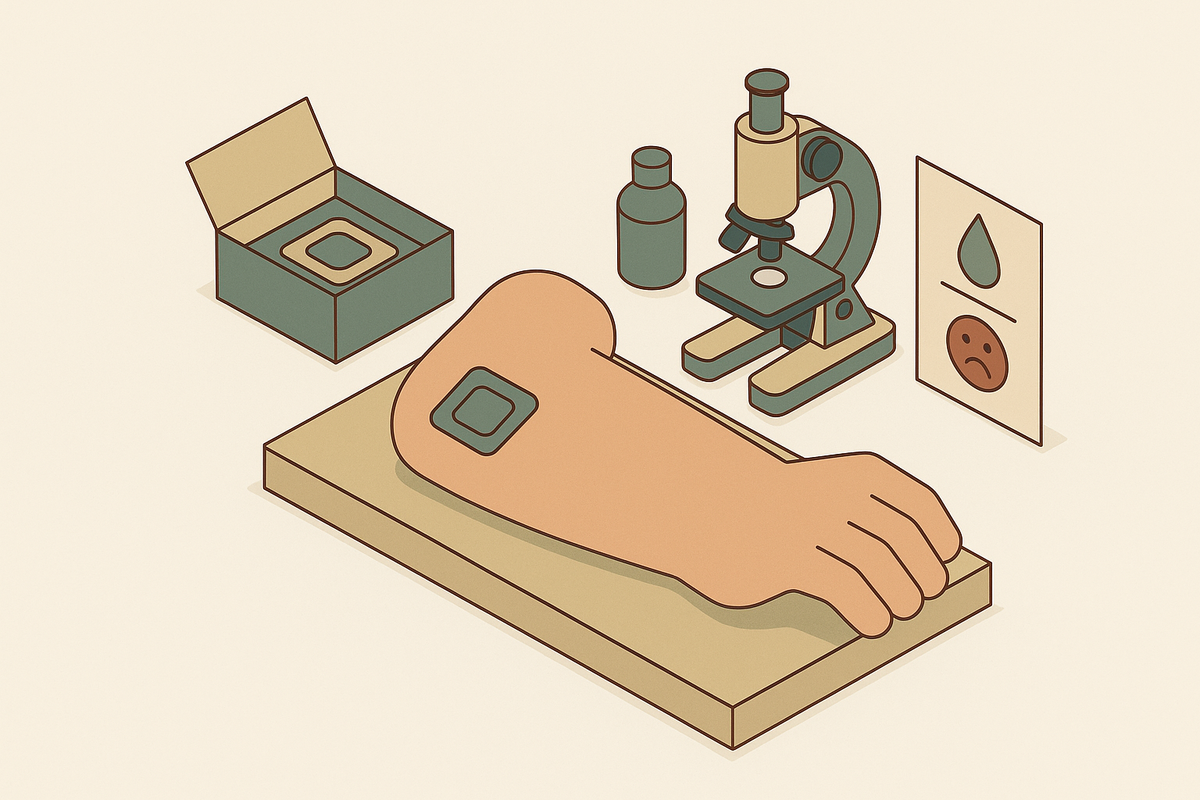
Formulating a transdermal patch for overnight sustained release
Skin's barrier and sweat make overnight drug delivery a three-part engineering puzzle.

Building a transdermal patch that works overnight is really three engineering problems stacked on top of each other. You have to get a drug through skin that spent millions of years evolving to keep foreign molecules out, you have to keep the release rate flat instead of spiking and crashing, and you have to make all of that hold up while the patient is horizontal, sweating, and rolling onto the thing at 3 a.m. Nearly every patch failure I've seen traces back to one of these three. Read enough patents in this space and you start to notice they're really just different bets on the same set of tradeoffs.
The Skin Doesn't Care About Your Formulation
Start with the stratum corneum, because everything downstream depends on it. It's about 15 to 20 micrometers of dead keratinocytes packed into a lipid matrix of ceramides, cholesterol, and free fatty acids, and it is, frankly, very good at its job. Most drugs applied to skin never reach the bloodstream at all. Pharmaceutical scientists use a rough cutoff called the 500 Dalton rule: above that molecular weight, passive diffusion across skin becomes vanishingly unlikely no matter what vehicle carries the drug. That single number eliminates most candidate molecules before formulation even begins.
The ones that survive tend to share a profile. Low molecular weight, a logP somewhere between 1 and 3 (lipophilic enough to partition into the lipid matrix, not so lipophilic it gets stuck there), and a low effective daily dose, usually under 10 mg. That last constraint gets underestimated constantly. Nicotine, fentanyl, scopolamine, estradiol, rotigotine: every drug that has made it to market as a patch works at a dose small enough that skin's limited flux capacity can still push a therapeutic amount through in 24 hours or less. You cannot patch your way around a drug that needs 500 mg a day. The math simply refuses to cooperate.
Zero-Order Kinetics, or Why Flat Beats Spiky
An overnight patch exists to deliver a flat release rate, what pharmacokineticists call zero-order kinetics: drug leaves the patch at a constant rate no matter how much is left inside. Compare that to a pill, where blood levels spike after absorption and decay as the liver clears the drug, producing the peaks and troughs behind a lot of side effects at the top of the curve and lost efficacy at the bottom. For a sleep aid or an overnight pain patch, the goal is steady blood levels from the moment a patient falls asleep to the moment they wake, no 2 a.m. peak, no 5 a.m. crash.
Two architectures get you there, and picking between them shapes the entire rest of the design.
The reservoir system holds a drug solution or gel in a sealed compartment, separated from skin by a rate-controlling membrane, usually a microporous or dense polymer like ethylene-vinyl acetate. As long as that reservoir stays saturated, flux across the membrane holds constant, because Fick's first law ties flux to the concentration gradient, and the gradient doesn't budge until the reservoir starts running dry near the end of wear time. Duragesic ran on this design for years. But if the membrane ruptures or gets sliced, you get dose dumping: the full reservoir releases at once. That failure mode is exactly what drove the reformulations and black-box warnings on fentanyl patches.
The alternative is a matrix system, sometimes called drug-in-adhesive, where the drug dissolves or suspends directly into the adhesive layer with no membrane at all. Thinner, cheaper, no rupture risk. True zero-order kinetics is harder to pull off here, though. As the outer layers deplete, the diffusion path to skin lengthens, and release tapers off along something closer to Higuchi kinetics, a square-root-of-time curve rather than a flat line. Formulators fight this by grading drug concentration higher toward the outer edge, or by oversaturating the matrix so it behaves more like a reservoir near saturation. Neither fix is free; both add cost and manufacturing complexity that a pure reservoir design doesn't carry.
Penetration Enhancers Do the Quiet, Dangerous Work
Even with the right molecule and the right kinetic architecture, most drugs still can't cross skin fast enough on their own to reach a therapeutic dose. That's the job of penetration enhancers, chemicals that temporarily loosen the stratum corneum's lipid packing. Oleic acid, propylene glycol, Azone (laurocapram): each works a little differently, some by fluidizing the lipid bilayers, some by pulling water into the stratum corneum to swell corneocytes and pry open diffusion channels.
The hard part is dosing the enhancer itself. Too little, and drug flux never gets high enough to matter. Too much, and you get irritation, erythema, or enough barrier disruption that the release rate stops behaving, which quietly undoes the zero-order design the whole patch was built around. Ethanol turns up constantly in transdermal systems, doing double duty as solvent and mild enhancer, but it evaporates once the patch seals against skin. A drying reservoir changes its own thermodynamic activity mid-wear. Formulators have to build for that shift, not just for day one.
Sleep Changes the Rules
Daytime patches deal with movement, showering, clothing friction. Overnight patches deal with heat retention under blankets, sweat pooling against the adhesive, and eight hours of unmonitored wear where nobody notices if an edge starts to lift.
Skin temperature climbs during sleep, especially under bedding, and permeability is temperature-dependent. Diffusion coefficients rise with temperature roughly along an Arrhenius relationship, so a patch calibrated for daytime skin can run hot overnight, literally, and push more drug across than intended. That's part of why some overnight formulations are built with conservative daytime flux targets on purpose: margin, so a few degrees of nighttime warming doesn't tip the dose into unsafe territory.
Adhesion is the other fight, and it's less glamorous but just as unforgiving. A patch has to survive someone rolling onto their side, sweating into the adhesive layer, and not noticing for hours if it starts to peel at the corner. Polyisobutylene and silicone adhesives dominate here because they tolerate skin's natural oils and moisture better than acrylics do under occlusion. Acrylics still get used where the adhesive needs to carry a higher drug load, since they hold more drug in solution than silicones typically allow. Trade one property for the other; nobody's found a way to get both for free.
Franz Cells Don't Lie, Even When You Want Them To
All of this gets tested against a Franz diffusion cell before it ever touches a live subject. Excised human or animal skin gets mounted between two chambers, drug formulation on one side, receptor fluid on the other, and cumulative permeation gets tracked over time to build the real flux curve. A formulation can look flawless on paper, right logP, right dose, sensible enhancer, and still fail a Franz cell study, because real skin carries batch-to-batch variability no model fully captures.
That variability is a large part of why transdermal timelines stretch on for years and why so few drugs ever migrate from oral or injectable form into a patch. Skin is a harder barrier to negotiate with than most people assume, patients included, and it doesn't grade formulations on effort.